
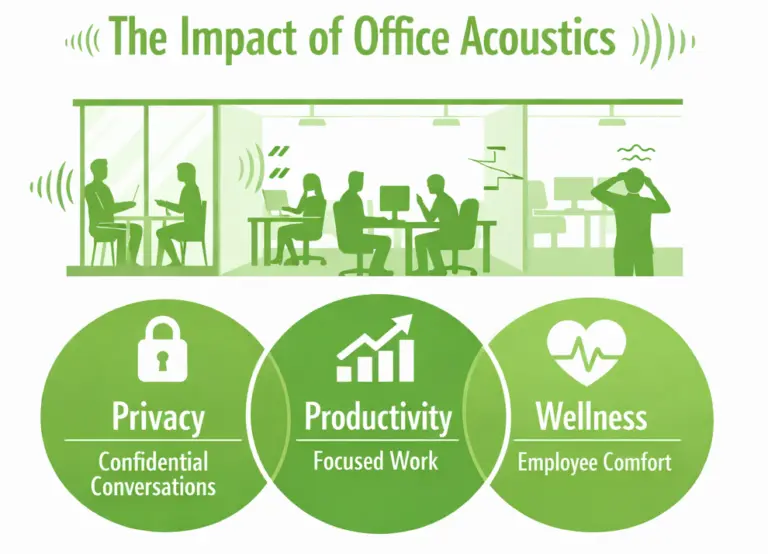
Noise and lack of privacy remain two of the most consistent complaints in the modern office. Even beautifully designed office spaces with open ceilings, collaborative areas, and sleek finishes often struggle with one invisible issue: office acoustics.
When organizations improve acoustics in office environments, they improve privacy, concentration, and overall wellness. And importantly, these improvements don’t always require tearing down walls or undergoing major construction. Thoughtful planning, calibrated sound masking systems, and strategic acoustic design can dramatically enhance comfort and performance in modern office environments.
Why Office Acoustics Is Often Overlooked in Workplace Design
Unlike lighting, furniture, or layout, office acoustics is invisible. You cannot see sound waves bouncing off reflective surfaces, traveling across open office space, or leaking through partition walls between meeting rooms. But employees feel the impact every day.
Many workplace leaders prioritize visual design elements like natural light and collaborative seating while unintentionally neglecting workplace acoustics. Yet the acoustic environment often shapes daily experience more than décor. In open office layouts and dynamic work environments, hard floors, high ceilings, and exposed surfaces amplify reflected sound, allowing unwanted sounds and distracting noises to build quickly.
Post-pandemic return-to-office trends have made this more noticeable. After working from home with greater control over ambient sound and background noise, employees are more sensitive to office noise and poor acoustics. That’s why solutions like sound masking in the workplace are becoming central to modern office acoustic strategies, helping organizations control sound without sacrificing collaboration or flexibility.
The Real Office Acoustics Problem Is Speech, Not Just Noise
Many leaders assume the primary issue in office acoustics is volume. In reality, the bigger challenge is speech intelligibility – how clearly conversations can be heard and understood, even at a distance.
A space can measure acceptable noise levels yet still feel highly distracting if conversations are clearly understood across open spaces. Direct sound from nearby phone calls or private discussions captures attention instantly. Our brains are wired to process speech — even when we try to ignore it.
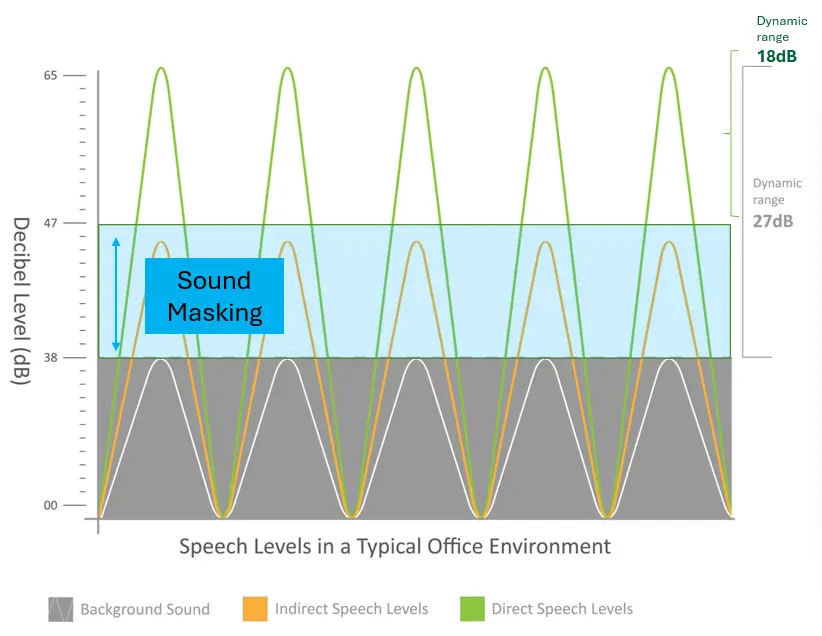
In open office space and open plan office environments, sound energy travels far, especially between conference rooms, adjacent rooms, and shared areas. Even moderate ambient noise becomes disruptive when speech is intelligible. Effective acoustics in office settings focus on managing speech privacy, not just reducing noise, by introducing consistent ambient sound that limits how far conversations can be understood and protects acoustic privacy.
How Poor Office Acoustics Impacts Productivity and Wellness
Poor acoustics create a constant cognitive burden. When employees are surrounded by distracting noises, phone calls, keyboard clicks, private conversations, the brain remains in a low-level state of alertness.
This ongoing processing:
- Disrupts focus
- Increases stress levels
- Contributes to fatigue
- Reduces deep work capacity
Even small but frequent noise distractions can disrupt focus repeatedly throughout the day. The result has a measurable impact on employee productivity and workplace satisfaction.
This is where the connection between office sound masking and productivity becomes clear. Studies and industry experience consistently show that improving workplace acoustics reduces noise distractions and supports better concentration.
This is not about eliminating all sound. A healthy acoustic environment includes balanced ambient sound that minimizes unwanted noise while preserving collaboration. Quality acoustics support both focus and interaction, two pillars of high-performing office environments.
Office Acoustics and the Return-to-Office Experience
When employees worked remotely, many gained greater control over their acoustic environment. They could manage background noise, close doors, or use white noise to reduce distractions.
Returning to shared open office environments reset expectations. Office noise that once seemed normal now feels excessive.
Poor office acoustics can undermine return-to-office strategies by:
- Increasing complaints about privacy
- Reducing collaboration quality
- Amplifying distractions that impact productivity
- Raising frustration in open plan office areas
Modern workplace acoustics must account for these new expectations. Organizations that prioritize acoustic comfort and speech privacy are seeing improved employee satisfaction and better engagement in shared office spaces.
Practical Ways to Improve Office Acoustics Without Major Construction
Facility managers and workplace leaders can enhance office acoustics without structural rebuilds. The key is thoughtful sound control, consistent planning, and strategic acoustic treatment.
Establish Consistent Background Sound Levels
Fluctuating sound levels increase distraction. When an office shifts between silence and sudden bursts of conversation, it amplifies awareness of every sound. Overly quiet offices can feel more disruptive than spaces with stable ambient sound.
Properly calibrated sound masking systems introduce controlled background noise to reduce speech intelligibility and stabilize the acoustic environment. This improves acoustic comfort without increasing excessive noise.
Using office acoustics strategically means maintaining predictable ambient noise that reduces noise distractions rather than eliminating sound entirely.
Reduce Echo and Manage Sound Build-Up
Modern office design often includes high ceilings, open spaces, hard floors, and reflective surfaces. While visually appealing, these elements increase reflected sound and sound bouncing. This build-up makes office noise feel louder and more chaotic.
Solutions include:
- Acoustic panels
- Sound absorbing materials
- Acoustic ceiling treatments
- Carpet or soft finishes
- Strategic placement of sound absorption elements
Improving acoustics in office settings often begins with absorbing sound and reducing reflected sound energy before adding other interventions.
Design for Speech Privacy in Key Zones
Not all office spaces serve the same purpose. Focus areas, private offices, conference rooms, and collaboration zones require different levels of acoustic privacy.
Speech privacy for shared spaces is especially critical in:
- Open office layouts
- Open plan environments
- Adjacent meeting rooms
- Areas handling private discussions
Strategic zoning combined with masking sound can significantly improve speech privacy. Solutions such as sound management for speech privacy help control sound transmission and limit speech intelligibility across open spaces.
The principles used to improve office acoustics are transferable to classrooms, healthcare spaces, and other environments where privacy and clarity must be balanced.
Why Calibration and Planning Matter for Office Acoustics
Calibration means adjusting sound levels and frequency output to match the specific acoustic environment. Without proper planning, even advanced sound masking technology may underperform.
Successful office acoustics strategies depend on:
- Assessing noise levels
- Identifying high distraction zones
- Measuring speech intelligibility
- Fine-tuning ambient sound distribution
Sound masking systems must be tuned to the office space, not simply installed.
A Simple Office Acoustics Checklist for Facility Managers
Improving workplace acoustics requires ongoing management, not a one-time fix.
Consider the following:
- Where are noise distractions happening most?
- When do complaints peak during the day?
- Which areas require speech privacy versus collaboration?
- Are conference rooms leaking sound into adjacent rooms?
- How will success be measured post-implementation?
- How will adjustments be handled after occupancy?
Workplace acoustics should evolve with layout changes, headcount shifts, and hybrid work patterns.
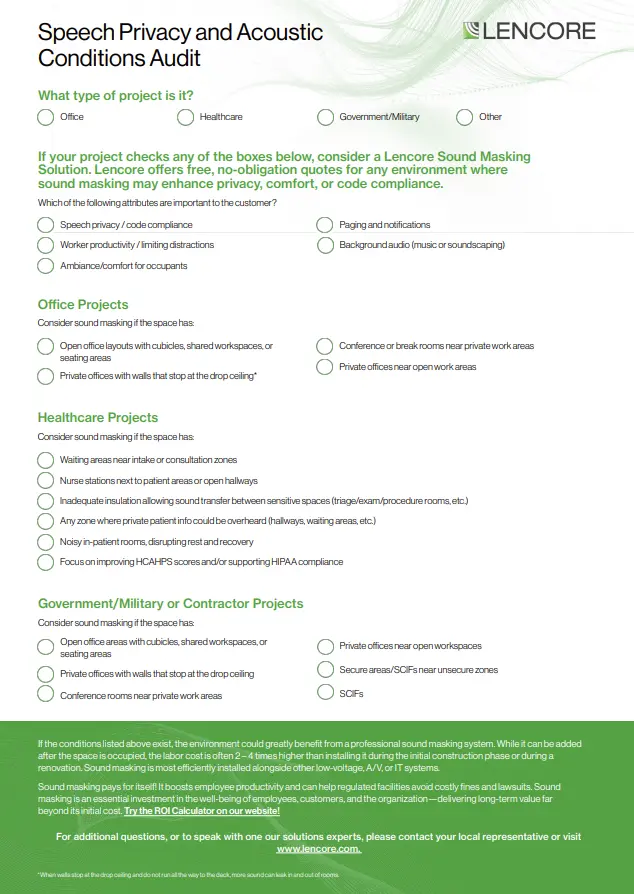
If you’ve considered these questions and are interested in sound masking solutions as the next step toward improving your acoustic environment, download Lencore’s Speech Privacy and Acoustic Conditions Audit.
Final Thoughts on Office Acoustics and the Employee Experience
Office acoustics directly influence privacy, productivity, and wellness. Poor acoustics disrupt focus and elevate stress. Thoughtful acoustic design supports collaboration while protecting speech privacy.
Better acoustics in office environments come from strategic planning, calibrated sound masking, and continuous evaluation.
Leaders who treat office acoustics as an ongoing workplace strategy and not a one-time adjustment create office environments that support both performance and well-being.
Explore Lencore’s workplace applications or speak with an expert about improving acoustic comfort and sound control in your office building.
Frequently Asked Questions About Office Acoustics
Why do open offices feel distracting even when they are quiet?
Office acoustics refers to how sound behaves within an office environment, including sound absorption, reflection, speech intelligibility, and ambient noise control. It shapes privacy, comfort, and employee productivity.
How can organizations improve acoustics in office environments without remodeling?
Organizations can introduce calibrated sound masking systems, add acoustic panels or sound absorbing materials, reduce reflective surfaces, establish consistent background noise levels, and adjust zoning for speech privacy. Major structural renovation is often unnecessary.
How do office acoustics affect employee productivity?
Poor acoustics increase noise distractions, disrupt focus, and elevate stress levels. Balanced ambient sound and improved speech privacy enhance concentration and support office sound masking productivity outcomes.
Are acoustic improvements only important for offices?
No. Classrooms, healthcare environments, and other shared spaces also require effective acoustic treatment and speech privacy management. The principles of workplace acoustics apply broadly across industries.