
Modern office environments have intensified concerns around speech privacy, distraction, and confidentiality. Open plan offices, shared meeting rooms, and hybrid collaboration spaces allow conversations to travel farther than most occupants expect. As a result, many workplaces struggle to protect confidential discussions while maintaining comfort.
Office sound masking systems have become a proven component of broader acoustical privacy strategies, including what many consultants refer to as noise management. When properly designed and calibrated, sound masking systems for office environments reduce speech intelligibility without increasing noticeable noise.
The most effective results occur when office sound masking systems are integrated into a layered acoustic strategy. Lencore supports this approach, reinforcing its role as a trusted authority in workplace acoustics and confidential office sound masking solutions.
Why Acoustical Privacy Is a Growing Challenge in Modern Offices
Modern office layouts prioritize openness and flexibility. Exposed ceilings, shared plenums, glass partitions, and collaborative zones increase speech intelligibility across adjacent spaces. Even when overall noise levels are moderate, conversations may remain clearly understood at surprising distances.
Confidential conversations in private offices and meeting rooms are often more audible than occupants expect. Construction details such as gaps above ceilings, unsealed penetrations, and underperforming doors frequently compromise separation.
Sound masking systems for office environments address these realities directly. As commercial buildings evolve, confidential office sound masking strategies must balance productivity, comfort, and confidentiality. Office sound masking systems introduce controlled background sound that reduces the clarity of human speech while maintaining a comfortable acoustic environment.
The Foundations of Effective confidential office sound masking Strategies
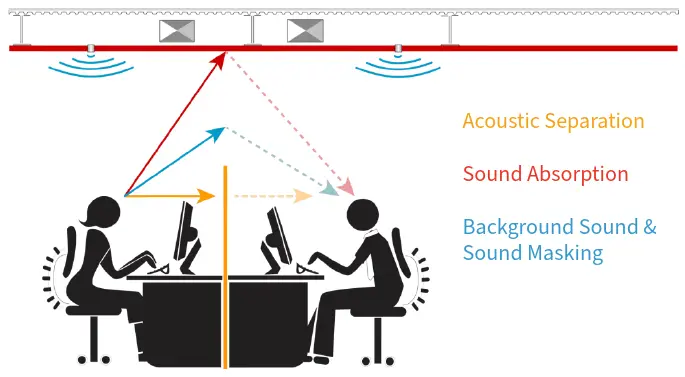
Consultants consistently point to three essential components of effective office sound masking:
- Acoustic separation
- Sound absorption
- Background sound and sound masking
No single product resolves privacy concerns on its own. Office sound masking systems perform best when integrated with physical construction and absorption strategies.
A layered system improves predictability. It also ensures that privacy performance is not dependent on one element alone.
Acoustic Separation
Acoustic separation relies on walls, doors, ceiling conditions, and construction continuity to block sound transmission. Closed rooms must extend fully to the deck above the ceiling. Doors must seal properly. Small gaps can significantly weaken performance.
Consultants frequently encounter situations where rated walls stop at the ceiling grid, leaving open pathways through the plenum. These oversights allow speech to travel into adjacent spaces.
While separation is critical for confidential conversations, it does not eliminate the need for background sound control. Even well-constructed rooms can allow speech to be heard outside when corridors are very quiet.
Sound Absorption
Sound absorption reduces reverberation and sound buildup within a space. Acoustic panels, ceiling treatments, and sound absorbing materials help control reflected sound and improve clarity inside rooms.
In open offices with hard finishes and exposed ceilings, absorption becomes especially important. It reduces incidental noises and limits the buildup of distracting sound energy.
However, absorption alone does not prevent speech from being understood across distances. It supports sound masking systems for office environments but does not replace them.
Background Sound and Sound Masking
Office sound masking systems introduce engineered background sound through strategically placed speakers. This sound is carefully tuned in frequency and volume to blend naturally into the workplace.
The objective is not to make the office louder. The goal is to reduce speech intelligibility. When masking sound is properly calibrated, conversations become less distinct and less distracting.
Sound masking systems for office use stabilize acoustic conditions throughout the day. As activity levels fluctuate, background sound remains consistent, helping maintain predictable acoustic comfort.
How Office Sound Masking Systems Improve Speech Privacy
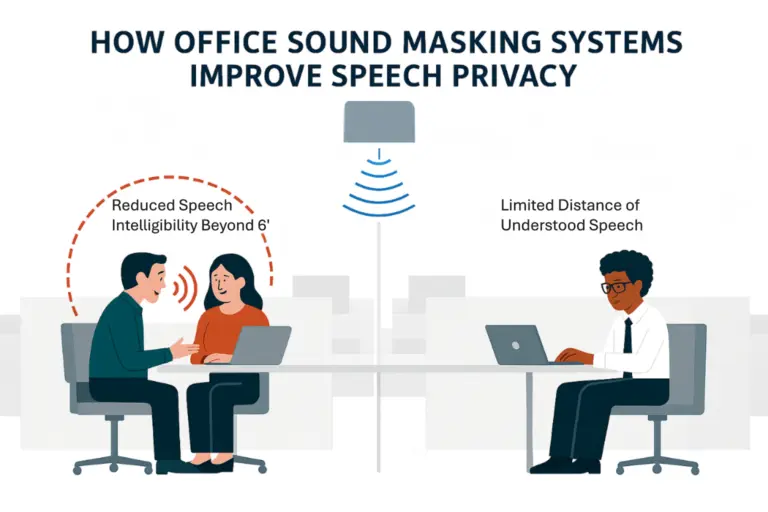
Acoustical consultants use office sound masking systems to improve speech privacy in both open offices and enclosed rooms. By introducing consistent background sound, these systems reduce the distance that conversations remain intelligible.
Very quiet environments often create more noticeable privacy problems. In silent corridors or low-noise open spaces, even low-volume speech can be clearly understood.
Sound masking systems for offices reduce how far human speech carries. Instead of hearing full conversations, occupants perceive blended ambient sound that masks speech patterns. This improves acoustic privacy without creating a loud or disruptive atmosphere.
Common Office Acoustical Challenges Identified by Consultants
Consulting experience reveals recurring patterns across office environments. These issues typically emerge after occupancy, when employees report distractions or concerns about confidentiality.
Common challenges include:
- Walls that do not extend fully to the structural deck
- Shared ceiling plenums that connect adjacent spaces
- Doors without adequate seals
- Corridors that are too quiet to support privacy
Office sound masking systems often provide an effective solution when construction alone cannot meet confidentiality goals.
Conference Rooms and Confidential Conversations
Conference rooms are expected to protect sensitive discussions. In practice, incomplete separation or quiet adjacent areas can allow speech to be heard outside the room.
Even when wall ratings are sufficient, the absence of controlled background sound can compromise confidentiality. Confidential office sound masking solutions help protect conversations when separation reaches its limits.
In tenant improvement scenarios, office sound masking systems offer a practical way to improve privacy without significant reconstruction.
Open Offices and Hybrid Workspaces
Open offices and hybrid workspaces often experience speech buildup and fluctuating activity levels. As teams collaborate, the overall sound environment shifts throughout the day.
Sound masking systems for office environments work best when paired with absorption. Together, they reduce distractions and maintain stable background conditions.
Office sound masking systems help reduce noticeable volume swings during busy periods. This supports focus, productivity, and long-term acoustic comfort.
Sound Masking vs Sound Cancellation: Clearing Up a Common Misconception
Active noise cancellation works effectively in small, controlled environments such as headphones and vehicles. It is not practical for large open plan offices.
Sound masking systems for office use do not cancel sound. They reduce speech intelligibility by introducing consistent background sound.
Accurate terminology is important. When expectations are set correctly, organizations understand how sound masking works and why it is effective within office sound masking.
Why Early Planning Matters for Office Sound Masking Systems
Acoustical issues are more difficult to address after occupancy. Once employees begin reporting distractions or confidentiality concerns, solutions may require retrofitting.
Setting privacy goals early allows consultants to recommend appropriate separation, absorption, and office sound masking systems during design.
When integrated from the beginning, sound masking systems for office environments perform more consistently and align with broader workplace objectives.
How Lencore Supports Effective Office Sound Masking Systems
Lencore partners with consultants, architects, and end users to deliver office sound masking systems that align with best practices in acoustical design.
Rather than positioning sound masking as a standalone fix, Lencore supports complete sound management solutions tailored to specific workplace requirements.
Engineered Sound Masking Solutions
Lencore provides scalable office sound masking systems designed to distribute engineered background sound evenly across varying square foot requirements.
These systems are calibrated to support speech privacy, acoustic comfort, and confidentiality in modern office environments.
Application-Specific Design Support
Office layouts vary across private offices, meeting rooms, open offices, and hybrid collaboration areas. Lencore supports customized configurations that reflect different privacy and comfort goals.
Sound masking systems for office use are adjusted to suit each space rather than applied uniformly.
Partnering With Consultants and Designers
Lencore collaborates closely with acoustical consultants and architects to ensure office sound masking systems integrate seamlessly into overall building design.
By supporting separation and absorption strategies, Lencore positions confidential office sound masking strategies as part of a comprehensive acoustical privacy system.
Final Thoughts on Office Sound Masking Systems and Acoustical Privacy
Office sound masking systems support confidentiality when they are thoughtfully designed and properly calibrated. They reduce speech intelligibility while maintaining comfort across open offices, meeting rooms, and hybrid environments.
Effective confidential office sound masking relies on layered solutions that combine separation, absorption, and background sound.
Organizations that approach acoustical privacy as a system-level decision are better positioned to protect confidential conversations, reduce distractions, and support productivity.
To learn more about office sound masking, explore Lencore’s solutions or connect with an expert to discuss your workplace requirements.
Frequently Asked Questions About Office Sound Masking Systems
What are office sound masking systems?
Office sound masking systems are engineered audio systems that introduce controlled background sound into a workplace. Their purpose is to reduce speech intelligibility and improve acoustic privacy in open offices, meeting rooms, and other shared environments.
How do sound masking systems for office environments improve speech privacy?
Sound masking systems for office environments reduce the distance that conversations can be clearly understood. By introducing consistent background sound, they make speech less distinct without making the space feel loud.
Are office sound masking systems the same as noise cancellation?
No. Noise cancellation attempts to eliminate sound and works in small controlled areas such as headphones. Office sound masking systems do not cancel sound. They reduce speech intelligibility by adding controlled background sound across a larger space.
Does office sound masking require construction changes?
Not always. While acoustic separation and absorption may involve construction elements, office sound masking systems can often be installed without major structural renovation. They are frequently used to improve privacy in existing commercial buildings.
Where are confidential office sound masking systems most beneficial?
Confidential office sound masking is especially beneficial in open offices, conference rooms, law firms, healthcare facilities, call centers, and any environment where protecting sensitive conversations is important.