

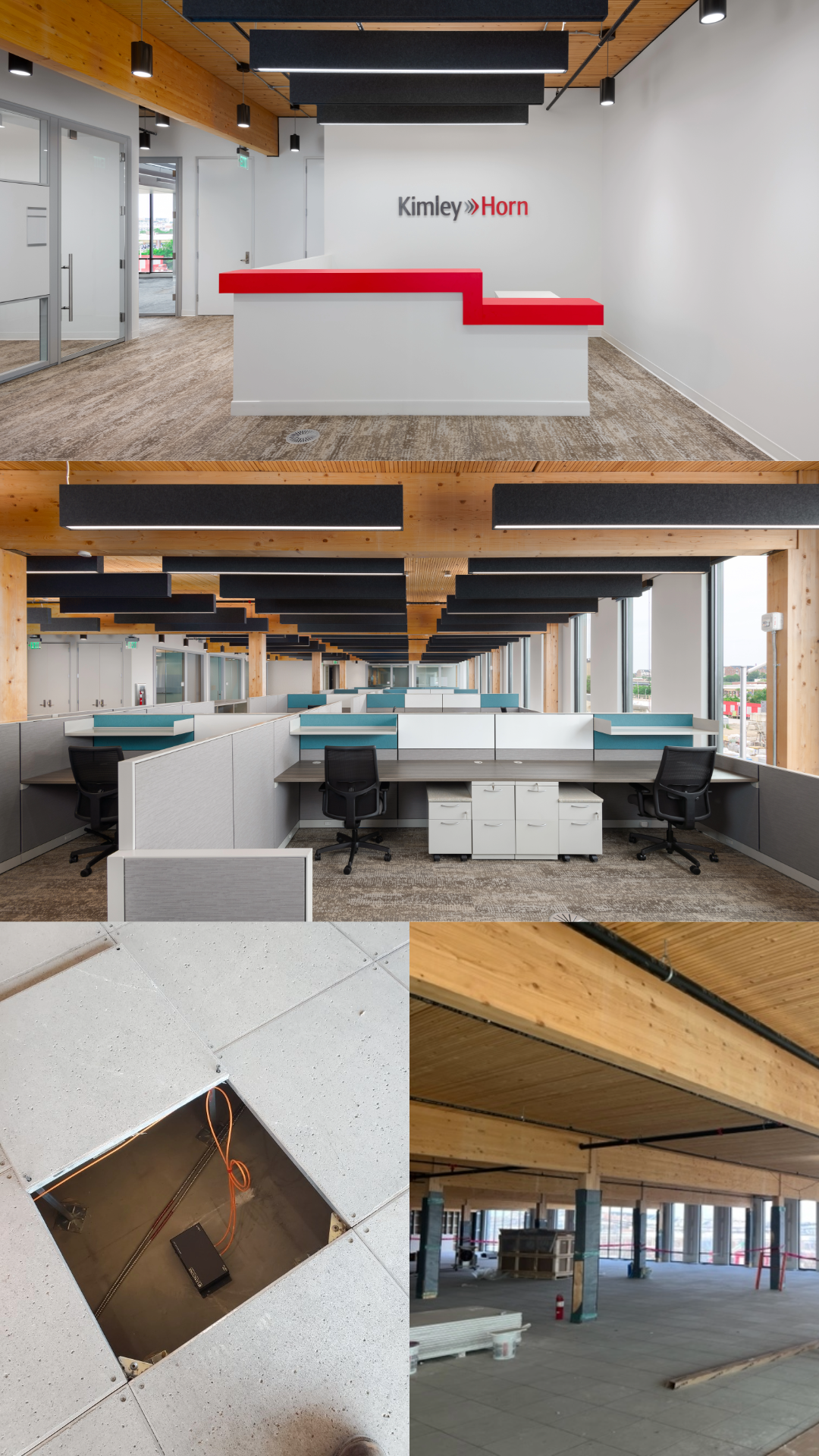
Kimley-Horn is a nationally recognized consulting firm specializing in civil engineering, supported by more than 30 additional technical disciplines that touch nearly every aspect of the built environment. With continued rapid growth, averaging approximately 60 new office builds or expansions each year, the firm places a strong emphasis on workplace environments that promote collaboration, focus, and consistency across locations. In Baltimore, Kimley-Horn relocated into a newly constructed all‑timber office building, the first of its kind in the area. While the firm was already established in the market, the move provided an opportunity to upgrade to a larger, more modern, high‑quality workspace that aligned with company standards while supporting a highly collaborative culture.
Lencore spoke with Ryan Wolff, who has spent 11 years at Kimley‑Horn—seven of them as Real Estate Project Manager—about the challenges this project posed and the innovative solution that made it possible to install sound masking despite landlord-imposed restrictions. Kimley-Horn joined the Baltimore project roughly three‑quarters of the way through base building construction and was among the first tenants to occupy the space. Early surveys and coordination efforts revealed that this would not be a typical tenant improvement project. The mass timber construction introduced unique acoustic considerations, including a landlord requirement to leave ceilings fully exposed. This eliminated the ability to install overhead systems. In addition, the space featured raised access floors, an uncommon design element for Kimley-Horn, and no drop ceiling. The absence of a drop ceiling removed a key layer of sound‑absorbing material. From a workplace planning standpoint, several factors increased the potential for distraction. The office maintains approximately 95 percent daily in‑office attendance, a 65/35 workstation‑to‑office ratio, and open work areas with mid‑height panels. Without a carefully planned acoustic strategy, speech noise and sound reflection could easily disrupt productivity in such a dense, collaborative environment.
Sound masking has long been part of Kimley-Horn’s workplace design strategy. As the firm expanded nationally and built a centralized real estate team, sound masking became a firmwide standard beginning in 2021.
After previously working with multiple manufacturers of these systems across regions, Kimley-Horn standardized on Lencore sound masking systems. Today, approximately 99 percent of the firm’s typical office buildouts include Lencore solutions.
For the Baltimore location, Lencore worked closely with Cooper & Co., its independent sales representative partner. Early in the process, they flagged that the raised access floor presented a challenge, but also an opportunity for a non‑traditional system design.
Since a traditional ceiling‑based installation was not feasible, Lencore engineered a sound masking solution integrated into the raised floor, using the i.Net system and G850 Flat Top Speakers—components specifically designed for underfloor applications and optimized to provide uniform sound dispersion through raised floors. This approach preserved the exposed timber ceiling while delivering consistent acoustic coverage throughout the space.
Throughout the project, Lencore provided system comparisons, design guidance, and coordination that minimized the burden on the Kimley-Horn team and helped keep the project on schedule.
The completed office delivers a comfortable acoustic environment that employees rarely notice, which is exactly the goal of effective sound masking. The system blends naturally into the background, similar to the ambient sound of HVAC equipment. It reduces speech intelligibility and minimizes distraction without interfering with collaboration.
Despite the unconventional installation method, end users experience no noticeable difference compared to a traditional ceiling‑based sound masking system. Most employees do not realize the system is operating until it is turned off, at which point the absence is immediately noticeable. Only minor tuning adjustments were needed after occupancy, and ongoing feedback has been minimal—a positive outcome from Wolff’s perspective. “It’s a technology that I don’t have to hear about,” he said. “Which means the process and the end result are going really well.”
The office now supports Kimley-Horn’s collaborative work style while maintaining acoustic comfort, even with high attendance and open workspace layouts.
“It’s really nice to have a vendor you can just send some information to. They take care of it all—I approve it, and it gets done when it needs to get done, no questions asked.” – Ryan Wolff, Kimley-Horn Real Estate Project Manager
THE TEAM
Sound Masking: Lencore Acoustics, LLC.
Real Estate Project Manager: Ryan Wolff, Kimley-Horn
Independent Sales Rep Firm: Cooper & Co
Architect: DLR Group – Dallas, TX