

Aging analog paging systems were built for a single building with dedicated speaker wiring, and they struggle the moment a facility grows, adds a second building, or connects to the network. When a warehouse expands or a campus adds a wing, running new home-run cable to every zone gets expensive and disruptive fast.
An IP paging system solves that problem by moving announcements onto the same network infrastructure a business already runs, so paging scales the way the rest of the organization does. This guide explains how IP and VoIP paging works, why facilities are switching from analog, how a network-based digital paging system offers a simpler alternative, and what to check before you buy.
The Lencore Music Page Interface (MPI) provides all the functionality of the i.Net MPI-2 and now supports SIP-based VoIP phone systems in addition to analog phone lines.
What Is an IP Paging System?
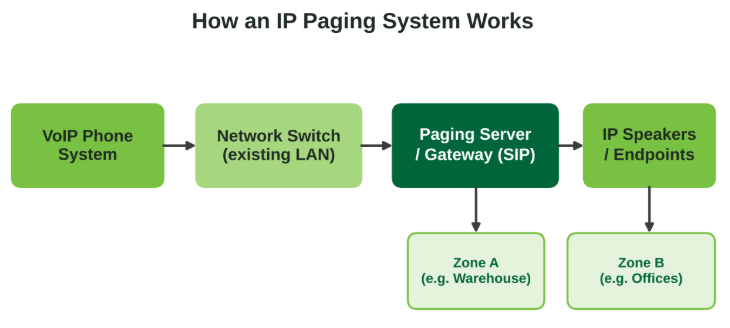
An IP paging system delivers audio announcements over standard network infrastructure instead of dedicated analog paging wire. In a true IP paging system, each speaker is an IP endpoint on the network, addressable individually or in zones, so a single platform can reach one room, one building, or an entire campus. The term “IP PA system” is used interchangeably in the market and describes the same thing: a public address system that runs on the network rather than on separate cabling.
A network-based digital paging system takes a simpler approach. Digital audio travels over the facility’s existing network to amplifiers that define the paging zones, and those amplifiers drive the speakers. There is no IP address to manage for every speaker, and with Lencore, paging runs through the same speakers as your sound masking.
It helps to draw a line between IP paging and a VoIP phone system. A VoIP phone handles one-to-one calls between people. An IP paging system is designed for one-to-many broadcast, sending the same message or alert to a group of speakers at once. A phone-only VoIP intercom lacks a dedicated one-to-many paging channel, which is why paging is treated as its own communication layer even when it shares the network with the phones. That design is what lets a facility broadcast live announcements, scheduled messages, and background music through the same set of speakers.
How Network-Based Digital Paging Works
The Music Page Interface (MPI) replaces all the bulky equipment associated with legacy music and paging systems with a simple card added to your system. The MPI’s technology is so sophisticated that it can allow zone additions, modifications, deletions, and other changes to the paging system on the fly, without rewiring or complicated configuration changes. The MPI leverages your investment in Lencore sound masking to provide a complete paging solution using the Lencore speakers, without legacy paging systems or complicated IP paging systems. The MPI can be connected to your existing SIP-based VoIP phone system or use an analog POTS telephone line.
Behind the scenes, the system carries digital audio over the facility’s network to Lencore amplifiers (OPs). The amplifiers define the paging zones and power the speakers, so the speakers themselves stay simple and never need to be network devices.
Integration with an existing VoIP phone system happens through SIP. The MPI connects to the phone system as a SIP client, much like another VoIP phone, so a phone extension can trigger a zone page or an all-call announcement directly from the handset. Staff page the loading dock, the front lobby, or the whole building using devices they already have, and IT manages the whole system alongside the rest of the network.
SIP Paging Systems
SIP, or Session Initiation Protocol, is the signaling standard that sets up and controls voice sessions on a network. Most modern VoIP phone systems already use SIP, which is why it has become the common language for connecting paging to the phone system. Some paging equipment acts as a SIP paging server; the Lencore MPI acts as a SIP client, registering with the phone system the same way a VoIP phone does. That means it can connect to almost any SIP-based VoIP phone system without custom middleware or protocol conversion. That compatibility is what lowers integration cost: there is no parallel system to buy and maintain. Confirming SIP support on the phone system is one of the first compatibility checks an integrator will run.
Benefits of Network-Based Paging Over Analog Systems for Businesses
For a growing business, the advantages of network-based paging over analog come down to scale, integration, and cost of change.
Scalability is the clearest benefit. Because network-based paging rides on existing network infrastructure, adding or changing a zone is a configuration change,, not a matter of pulling new dedicated wiring runs across the site. Multi-building and multi-campus operations manage every location from one platform.
Integration is the second benefit. Network-based paging connects to existing VoIP phone systems through SIP, and with Lencore, paging, background music, and sound masking all run through the same speakers. Business paging systems built this way keep announcements targeted to the right zones instead of blasting the whole building.
Centralized control matters day to day. Zone-based paging and system settings are managed from a single web interface, so the team adjusts volume, groups, and schedules without visiting a rack. And the cost and disruption angle is real for occupied or historic buildings: installation uses standard category cabling with minimal construction, which keeps a live facility running during the upgrade.
What to Look for in a Network-Based Paging System
A short checklist keeps an evaluation focused:
- Compatibility with your existing network and phone system, whether that is a SIP-based VoIP platform or an analog POTS line.
- Audio quality and speaker coverage that match your zone requirements, so every area gets clear, intelligible announcements without dead spots or overload.
- Compliance and integration needs for regulated facilities, which vary by industry and often drive the specification.
Overhead paging systems are deployed across a wide range of environments, and these paging systems carry different requirements in each one:
- Hospitals and clinics, where paging systems for hospitals must work alongside nurse call and other clinical systems, and privacy rules apply.
- Schools and universities, where clear campus-wide announcements keep students and staff informed.
- Warehouses and industrial sites, where high ambient noise demands strong speaker coverage across large open zones.
- Corporate offices and open floor plans, where zone paging keeps announcements targeted rather than disruptive.
- Government and municipal buildings, where integration with existing building systems and procurement standards apply.
Decision
For any facility already invested in VoIP or networked infrastructure, network-based paging is the recommended path. It reuses what you already run, integrates with the phone system, and scales without new dedicated paging wiring. For facilities that already use Lencore sound masking, the MPI adds paging to the speakers already in place, without the complexity of a full IP paging system. Analog remains viable only for small, single-building sites that have no networking requirement and no plans to grow, where the simplicity of a stand-alone system outweighs the flexibility of a networked one.
Next Step: Assess Your Facility’s Paging Needs
The fastest way to know what your building needs is to start with the network you already have. A short assessment reviews your existing infrastructure, zones, and integration requirements, then maps them to the right configuration. Reach out to Lencore paging systems to request a paging system assessment or to talk to a Lencore integrator about the right platform for your facility.